

Launching a new website is exciting, but getting it noticed in search engines can be challenging. One major reason is that your website has not yet established a strong online reputation or earned links from other trusted websites. This makes building visibility and competing with established websites more difficult.
Backlinks can help search engines discover your content and understand how other websites reference it. However, getting hundreds of random links will not necessarily improve your SEO. What matters is earning relevant, trustworthy backlinks that provide genuine value to readers.
In this guide, you will learn how to build quality backlinks for a new website using seven practical strategies. You will also discover how to evaluate backlink opportunities, avoid common mistakes, and follow a 30-day link-building plan.
1. Understand What Makes a Backlink Valuable
A backlink is a hyperlink from another website that points to a page on your website. For example, if a marketing blog references your SEO guide and links to it, your website receives a backlink.
Backlinks can help search engines discover pages and understand relationships between websites. They can also bring referral traffic, introduce your brand to new audiences, and support your website’s visibility.
However, not every backlink offers the same value.
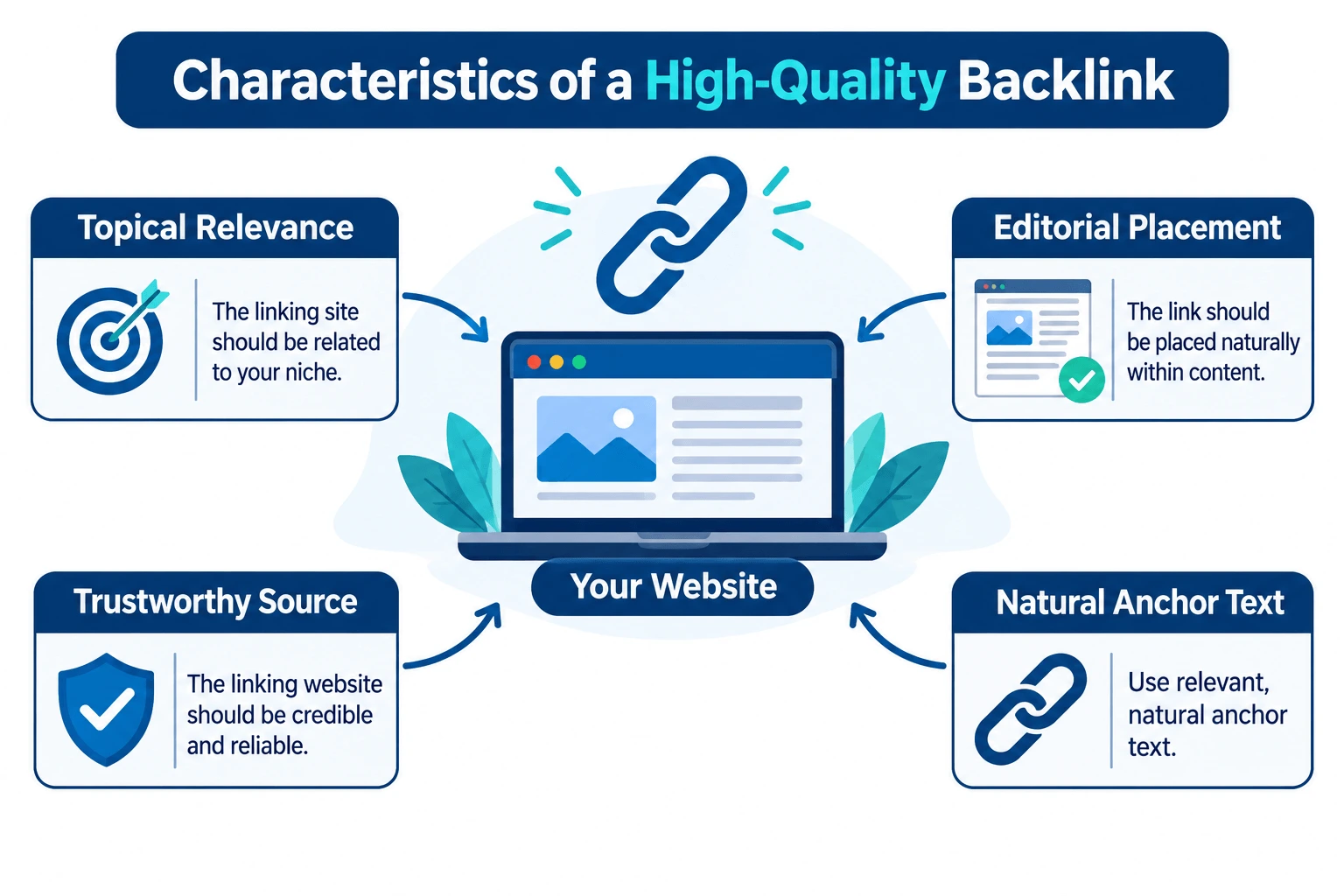
Characteristics of a High-Quality Backlink
A valuable backlink generally has several important characteristics:
- Topical relevance: The linking website covers subjects related to your industry or content.
- Editorial placement: The link appears naturally within useful content rather than being inserted solely for SEO.
- Audience value: Visitors can benefit from following the link.
- Website credibility: The linking website publishes useful, trustworthy information.
- Relevant anchor text: The clickable text accurately describes the linked page.
- Natural context: The surrounding paragraph explains why the link is useful.
For example, a backlink from a respected digital marketing publication to your SEO tutorial is usually more relevant than a random link from an unrelated entertainment directory.
Dofollow vs. Nofollow Backlinks
Dofollow is a common industry term for a standard link without a special link qualification attribute. Nofollow links contain rel="nofollow", which tells search engines not to associate the usual endorsement signals with that link.
Paid placements should generally use rel="sponsored" or rel="nofollow". User-generated links may use rel="ugc".
Do not focus exclusively on dofollow backlinks. Nofollow links can still generate referral traffic, brand exposure, and potential business opportunities.
2. Prepare Your Website Before Building Backlinks
Before contacting website owners, make sure your website deserves attention. Editors are more likely to consider linking to a useful resource than to an incomplete website with little original content.
Start with these basic improvements:
- Publish informative, original articles.
- Create professional About, Contact, and service pages.
- Make sure your website works properly on mobile devices.
- Improve loading performance and navigation.
- Check that important pages are accessible to search engines.
- Use internal links to connect related articles and important pages.
A strong foundation also helps visitors trust your business when they arrive through external links.
Create Content Worth Linking To
One of the most sustainable ways to earn natural backlinks is to publish resources that other website owners genuinely want to reference.
Consider creating:
- Original research and industry statistics.
- Detailed tutorials and educational guides.
- Free checklists, templates, and downloadable resources.
- Case studies showing real results.
- Useful calculators or interactive tools.
For example, a digital marketing website could publish a free SEO audit checklist. Bloggers, marketing professionals, and business owners may reference it when explaining website optimization.
The key is to provide information that adds something useful to existing discussions.
Identify Your Most Important Pages
Not every page needs to attract backlinks. Start by identifying pages that offer the greatest value to your audience.
These might include your homepage, core service pages, educational articles, original research, and useful resources.
Choose the most relevant destination for each backlink opportunity. A link from an article about keyword research should ideally point to a useful keyword research resource, not an unrelated homepage.
3. Seven Proven Strategies to Build Quality Backlinks for a New Website
Once your website is ready, start finding relevant opportunities. The following strategies can help beginners earn backlinks without depending on automated link-building schemes.
1. Build Backlinks Through Guest Posting
Guest posting involves contributing an original article to another website in your industry. In return, the publisher may allow an appropriate author or resource link.
Follow these steps:
- Find publications that cover topics related to your niche.
- Review their existing articles and contribution guidelines.
- Suggest topics that their readers would find useful.
- Prepare original, well-researched content.
- Include relevant links only where they genuinely help readers.
For example, a web development agency could pitch an article about website speed optimization to a relevant technology publication.
Focus on editorial quality and audience relevance. Avoid mass-produced guest posts created mainly to manipulate search rankings.
2. Use Broken Link Building
Broken link building involves finding outdated or unavailable resources on relevant websites and suggesting a suitable replacement.
Here is how to approach it:
- Find resource pages and educational articles in your niche.
- Check for external links that no longer work.
- Identify what the missing resource originally covered.
- Find or create a genuinely useful replacement on your website.
- Contact the website owner with a helpful explanation.
For example, if a marketing resource page links to a deleted SEO checklist, you could suggest your own updated checklist if it covers the same subject.
The replacement must genuinely serve the same purpose. A broken link is an opportunity to help the publisher, not an automatic reason to request a backlink.
3. Find Competitor Backlink Opportunities
Competitor backlink analysis helps you discover websites that already reference businesses or resources in your industry.
Use tools such as Ahrefs or Semrush to examine competitor referring domains and identify relevant linking pages.
Look for:
- Industry publications.
- Resource collections.
- Educational articles.
- Business associations.
- Expert contribution opportunities.
Next, assess whether the same opportunity makes sense for your website. A competitor’s backlink profile is a research starting point, not a list of links you should copy blindly.
4. Submit Your Website to Relevant Business Directories
Legitimate business directories can help new businesses become discoverable.
Start with reputable platforms such as local business listings, industry associations, professional organizations, and niche-specific directories.
Before submitting your website, check:
- Whether the directory is relevant to your business.
- Whether it contains real businesses and useful listings.
- Whether visitors actually use the platform.
- Whether your business information is accurate.
Avoid submitting your website to hundreds of low-quality directories simply to collect backlinks. A small number of relevant listings is more useful than a large collection of irrelevant ones.
5. Earn Links Through Digital PR and Expert Contributions
Digital PR focuses on earning coverage from publications, journalists, bloggers, and industry experts.
You can create opportunities by:
- Sharing original research and statistics.
- Providing expert commentary.
- Publishing useful industry reports.
- Responding to relevant journalist requests.
- Offering practical insights on emerging industry topics.
For example, an SEO agency could publish research about common website optimization problems experienced by small businesses. A relevant publication might reference the findings in its own article.
Focus on original information rather than sending generic promotional announcements.
6. Reclaim Unlinked Brand Mentions
Sometimes other websites mention your business without including a hyperlink.
These references are called unlinked brand mentions. Finding them can be easier than approaching publishers who have never heard of your business.
Search for your brand name using Google. You can also monitor mentions with available brand-monitoring tools.
When you find a relevant mention:
- Visit the original article.
- Check whether your website is already linked.
- Identify a suitable page to reference.
- Contact the publisher politely.
- Explain how adding a link would help readers find your business.
Remember that publishers are not obligated to add links. Make a helpful request rather than treating every mention as a backlink opportunity.
7. Build Relationships Through Communities and Resource Pages
Participating in relevant professional communities can help your business develop relationships and gain visibility.
Consider industry forums, professional groups, educational communities, and curated resource pages.
Contribute by answering questions, sharing useful information, and helping other members solve problems. When appropriate, suggest your own resource to a publisher maintaining a relevant resource collection.
For example, a website offering free SEO tools could approach a digital marketing resource page and explain how its tool helps website owners identify optimization issues.
Avoid dropping promotional links into unrelated discussions. Your contribution should be valuable even if nobody clicks your website link.
4. How to Evaluate a Backlink Before Pursuing It
Before spending time or money on a backlink opportunity, evaluate the website and the specific page where your link would appear.
A simple evaluation checklist includes:
- Is the website relevant to your niche?
- Does it publish useful original content?
- Does it attract a genuine audience?
- Is the linking page relevant to your target page?
- Would visitors benefit from the link?
- Is the placement editorially appropriate?
- Does the website have a history of publishing spammy content?
Important Metrics to Check
SEO tools provide useful measurements for backlink research. Some commonly used metrics include:
| Metric | What it measures |
|---|---|
| Domain Rating (DR) | Ahrefs’ estimate of a domain’s backlink strength |
| Domain Authority (DA) | Moz’s estimate of ranking potential |
| Organic traffic | Estimated search-engine traffic |
| Referring domains | Number of unique domains linking to a website |
| Trust Flow | Majestic’s measure related to link quality |
These are third-party metrics, not official Google ranking scores. A website with a high DA or DR is not automatically a good backlink source.
Evaluate topical relevance, editorial quality, traffic, and the actual linking page together.
Backlinks You Should Avoid
Avoid automated backlink packages, private blog networks built to manipulate rankings, irrelevant directories, hidden links, excessive reciprocal linking, and keyword-stuffed placements.
Google identifies buying or selling links intended to manipulate rankings, automated link creation, and excessive link exchanges as examples of link spam.
If you pay for advertising or sponsored coverage, make sure the publisher qualifies the link appropriately. See Google’s spam policies for further guidance.
5. Create a Practical 30-Day Backlink Building Plan
A new website does not need a complicated link-building campaign from day one. Start with manageable tasks and improve your approach as you learn which opportunities work.
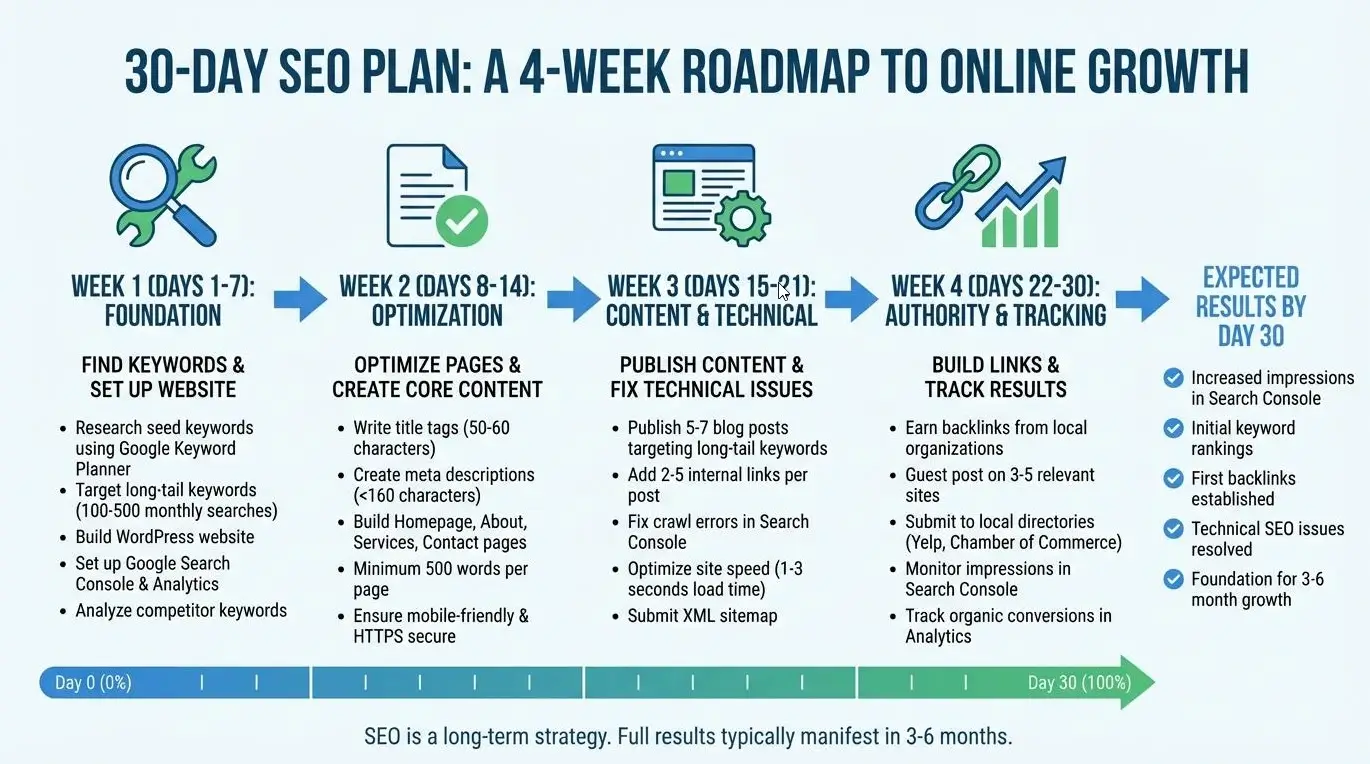
Week 1: Website Preparation and Research
- Review your website’s technical condition.
- Publish two or three useful resources, where appropriate.
- Identify five to ten relevant competitors.
- Research potential linking websites.
- Prepare a backlink prospect spreadsheet.
Week 2: Start Outreach and Guest Posting
- Identify suitable guest contribution opportunities.
- Prepare personalized outreach messages.
- Contact relevant editors and website owners.
- Find broken links on industry resource pages.
Week 3: Build Relationships
- Analyze competitor referring domains.
- Identify unlinked brand mentions.
- Participate in relevant professional communities.
- Respond to suitable expert contribution requests.
- Follow up on previous outreach where appropriate.
Week 4: Review and Improve
- Check newly discovered backlinks.
- Review referring domains and linked pages.
- Identify which outreach messages received responses.
- Evaluate the quality of acquired links.
- Plan the next month’s activities.
Treat this as a starting framework, not a guaranteed backlink target. Your results will depend on your niche, resources, content quality, and outreach efforts.
View Pricing
6. Common Backlink Building Mistakes New Website Owners Should Avoid
Beginners sometimes focus on collecting backlinks without considering whether those links make sense for their website.
Avoid these common mistakes:
- Chasing quantity: Hundreds of irrelevant links are not a substitute for relevant references.
- Buying manipulative links: Paid placements that pass ranking credit can violate Google’s spam policies.
- Ignoring relevance: A link should make sense in the context of the linking page.
- Overusing exact-match anchors: Repeated keyword-heavy anchors can make a backlink profile look unnatural.
- Using automated tools: Mass-generated links rarely provide genuine editorial value.
- Expecting instant results: Search visibility depends on multiple factors, not backlinks alone.
Build a sustainable strategy around useful content, relevant relationships, and genuine editorial references.
7. Best Tools to Find and Monitor Backlinks
You do not need expensive software to start building backlinks. Several tools can help you research opportunities and monitor your website.
Free Backlink Research Tools
- Google Search Console: View Google’s discovered external links, top linking websites, and top linked pages.
- Bing Webmaster Tools: Monitor website performance and explore available backlink information.
- Google Search: Find guest contribution opportunities, resource pages, and industry publications using targeted searches.
Paid Backlink Analysis Tools
- Ahrefs: Research competitor backlinks, referring domains, and link opportunities.
- Semrush: Explore backlink gaps, competitor link profiles, and outreach prospects.
- Moz: Review Domain Authority and other link-related metrics.
- Majestic: Analyze Trust Flow, Citation Flow, and backlink profiles.
Paid tools can make research more efficient, but they are optional when starting a small link-building campaign.
Free SEO Analyzer
Frequently Asked Questions
1. How many backlinks does a new website need?
There is no fixed number of backlinks required for a new website. Focus on earning relevant links from trustworthy websites rather than targeting an arbitrary backlink count.
2. How can I get backlinks for a new website for free?
Create useful content, contribute expert insights, approach relevant resource pages, participate in professional communities, and build relationships with publishers.
3. Are dofollow backlinks better than nofollow backlinks?
Standard links can provide ranking signals, while nofollow links are qualified differently. Both can bring visitors, brand exposure, and valuable referral opportunities.
4. How long does it take for backlinks to show SEO results?
There is no guaranteed timeline. Search engines need to discover and process links, and any ranking changes depend on competition, content quality, and other SEO factors.
5. Can a new website rank without backlinks?
Yes. A new website can rank for suitable searches without an established backlink profile, particularly when its content satisfies search intent and competition is manageable.
6. Is buying backlinks safe for a new website?
Buying links intended to manipulate search rankings violates Google’s link spam policies. Paid advertising and sponsored placements should use appropriate link attributes.
7. What is the best backlink strategy for beginners?
Start with valuable content, relevant guest contributions, legitimate business listings, personalized outreach, and relationship-based link building. Prioritize opportunities that benefit readers.
Conclusion: Build Backlinks Through Quality, Relevance and Consistency
Learning how to build quality backlinks for a new website is about more than finding websites willing to link to you. It requires useful content, thoughtful outreach, industry relationships, and careful evaluation of backlink opportunities.
Start with a strong website foundation, implement the seven strategies, and follow the 30-day action plan. Focus on earning genuine references instead of collecting random links.
With consistent effort and a quality-first approach, you can gradually develop your website’s reputation, attract relevant visitors, and build a stronger foundation for long-term SEO growth.



Leave a Comment