
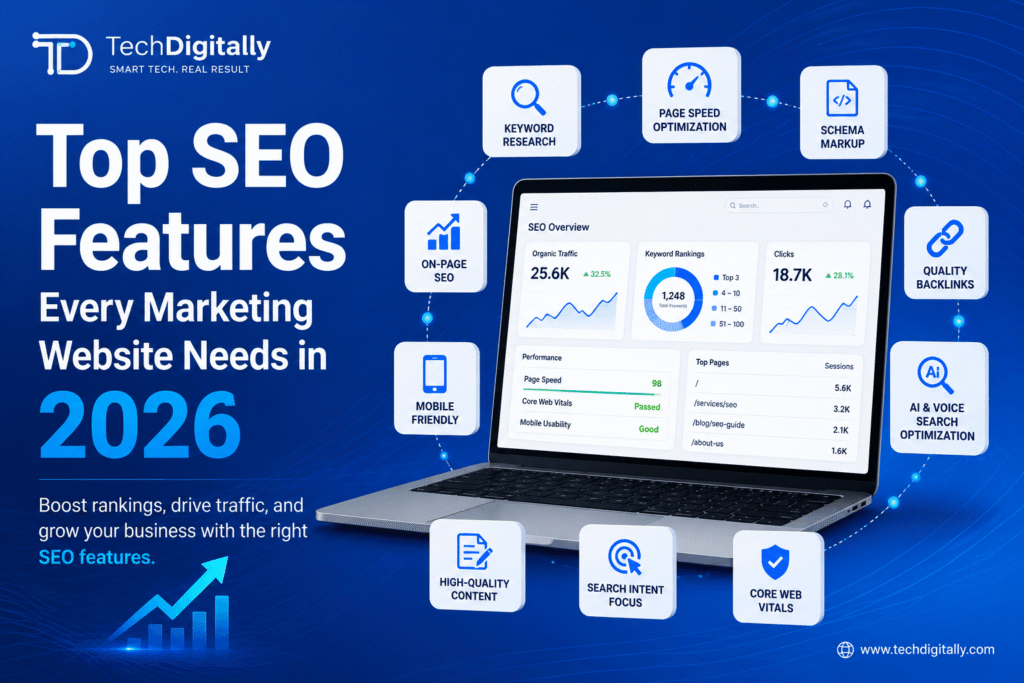
Marketing websites often launch with beautiful designs, impressive animations, and polished branding but lack the SEO foundations required to generate consistent organic traffic. SEO features for marketing websites should therefore be planned before development begins rather than added after launch or a major rebrand.
In 2026, successful search optimization requires much more than adding keywords to web pages. The most effective SEO features for marketing websites include crawlable architecture, optimized metadata, fast page experiences, search-intent-focused content, internal linking, structured data, mobile optimization, and trustworthy information.
When designers, developers, content writers, and SEO specialists collaborate from the beginning, businesses can create websites that are easier for search engines to crawl and understand while providing a better experience for visitors.
SEO Features for Marketing Websites Every Business Needs
A modern marketing website needs a combination of technical, on-page, content, performance, and measurement features to compete effectively in organic search.
Before launching a website, teams should consider:
- Search-friendly website architecture
- Crawlable HTML
- XML sitemaps
- Robots.txt configuration
- Canonical URLs
- Optimized title tags and meta descriptions
- Proper heading hierarchy
- Internal linking
- Image optimization and descriptive alt text
- Mobile responsiveness
- Core Web Vitals optimization
- Structured data
- Helpful and original content
- E-E-A-T trust signals
- Analytics and conversion tracking
- Regular technical SEO monitoring
These SEO features for marketing websites should be included in the planning and development process instead of being treated as optional improvements after launch.
Technical SEO Features for Marketing Websites
Technical SEO provides the foundation that allows search engines to discover, crawl, render, and understand your website.
A marketing website can have excellent content and an attractive design, but technical problems can prevent important pages from receiving the visibility they deserve.
Crawlable Website Architecture
Search engines use automated crawlers to discover website pages. A logical architecture makes it easier for crawlers to understand the relationship between different sections of a website.
A typical marketing website structure might look like:
Homepage → Services → Individual Service → Supporting Content
For example:
Homepage → SEO Services → Technical SEO → Core Web Vitals Guide
This structure creates clear relationships between commercial pages and supporting informational content.
XML Sitemaps
An XML sitemap provides search engines with a structured list of important URLs.
It is especially useful for:
- New websites
- Large websites
- Frequently updated websites
- E-commerce websites
- Websites with complex structures
Make sure the sitemap does not unnecessarily contain redirected, broken, duplicate, or noindex URLs.
Robots.txt
The robots.txt file provides crawling instructions to search engine bots.
Before launch, verify that important pages are not accidentally blocked.
Your SEO team should check that robots.txt does not prevent access to:
- Service pages
- Product pages
- Blog posts
- Important resources
- Required CSS and JavaScript files
Canonical URLs
Canonical tags help search engines identify the preferred version of a URL when similar or duplicate URLs exist.
This is especially important for websites that use:
- Filtering systems
- Sorting parameters
- Tracking parameters
- Multiple URL variations
- Duplicate content
Canonical implementation should be reviewed carefully as part of the technical SEO process.
On-Page SEO Features for Marketing Websites
On-page optimization helps search engines understand what individual pages are about while making content easier for visitors to navigate.
Optimized Title Tags
Every important page should have a unique and descriptive title.
For example:
SEO Features for Marketing Websites | TechDigitally
is more informative than:
Home | TechDigitally
Your title should accurately represent the page and align with the user’s search intent.
Meta Descriptions
Meta descriptions summarize page content and can influence whether users choose your result in search.
A good meta description should:
- Describe the page accurately
- Match search intent
- Include the main topic naturally
- Encourage clicks
- Avoid keyword stuffing
Heading Structure
Use a clear heading hierarchy.
For example:
H1: SEO Features for Marketing Websites
H2: Technical SEO Features
H3: XML Sitemaps
H3: Robots.txt
H2: On-Page SEO Features
H3: Title Tags
This structure improves readability and makes long-form content easier to scan.
Core Web Vitals and Performance
Website performance is an important part of the overall user experience.
Core Web Vitals include:
- LCP (Largest Contentful Paint) — loading performance
- INP (Interaction to Next Paint) — responsiveness
- CLS (Cumulative Layout Shift) — visual stability
Marketing websites often contain large images, videos, animations, tracking scripts, forms, and third-party integrations. Without optimization, these elements can make pages slower.
Useful performance improvements include:
- Compressing images
- Using appropriate image dimensions
- Loading images efficiently
- Deferring non-critical JavaScript
- Removing unnecessary scripts
- Optimizing CSS
- Using browser caching
- Improving server response time
- Using a CDN when appropriate
- Optimizing web fonts
Performance should be tested on both desktop and mobile devices.
Structured Data and Schema Markup
Structured data helps search engines understand specific information on a webpage.
Depending on the website, relevant schema types may include:
- Organization
- WebSite
- BreadcrumbList
- Article
- Service
- Product
- LocalBusiness
- FAQPage
Schema should accurately represent information visible on the page. It should not be added simply to manipulate search results.
Content Features for Marketing Websites
Great technical SEO cannot compensate for content that fails to satisfy the visitor.
Marketing websites should create content around real customer questions, problems, needs, and search intent.
Useful content can include:
- Service pages
- Product pages
- Case studies
- Industry pages
- Comparison articles
- Tutorials
- Research reports
- FAQs
- Guides
- Customer success stories
Each page should have a clear purpose.
Instead of creating multiple pages targeting almost identical keywords, create comprehensive resources that genuinely help visitors.
Internal Linking
Internal links connect related pages across your website.
For example, a digital marketing agency might connect:
SEO Services
→ Technical SEO
→ On-Page SEO
→ Link Building
→ Keyword Research
→ SEO Analytics
→ Local SEO
→ SEO Audit
This structure helps users discover additional resources and helps search engines understand the relationships between topics.
Use descriptive anchor text that accurately explains the destination.
Image SEO Features
Images can improve visual engagement, but they can also increase page weight if they are not optimized.
For better image SEO:
- Compress images
- Use descriptive file names
- Choose appropriate dimensions
- Use modern formats when appropriate
- Add meaningful alt text
- Avoid unnecessarily large files
- Lazy-load suitable below-the-fold images
For the featured image in this article, use:
Alt text: SEO features for marketing websites
The image itself should be relevant to the article rather than using the keyword as an unrelated alt attribute.
E-E-A-T and Trust Signals
Modern marketing websites should make it clear why visitors should trust the company and its information.
Useful trust signals include:
- Author information
- Company information
- Client testimonials
- Case studies
- Portfolio examples
- Client logos
- Contact information
- Business address where appropriate
- Professional credentials
- Original research
- Accurate references
- Clear editorial policies
E-E-A-T is not simply a plugin setting. Trust is demonstrated through the overall quality, accuracy, transparency, and credibility of a website.
Mobile SEO
Mobile optimization should be included among the essential SEO features for marketing websites.
Check that mobile visitors can easily:
- Navigate menus
- Read text
- Complete forms
- Tap buttons
- View images
- Access important content
- Use interactive elements
Avoid intrusive elements that make content difficult to access on smaller screens.
Analytics and SEO Measurement
SEO performance should be measured using more than keyword rankings.
Connect your website with tools such as:
- Google Search Console
- Google Analytics
- Conversion tracking
- SEO crawling tools
- Rank tracking platforms
- Performance monitoring tools
Monitor:
- Organic clicks
- Search impressions
- Click-through rate
- Organic conversions
- Leads
- Revenue
- Landing-page performance
- Search queries
- Indexed pages
- Technical errors
- Core Web Vitals
The ultimate objective is to connect organic search visibility with meaningful business results.
Conversion Optimization
A marketing website should not simply attract visitors. It should guide qualified visitors toward a useful next step.
Depending on the business, calls to action may include:
- Request a quote
- Book a consultation
- Contact the team
- Start a free trial
- Download a resource
- Request a demo
- Purchase a product
SEO and conversion optimization should work together.
A page that receives thousands of visitors but produces no qualified leads may need a stronger content strategy, better targeting, or improved conversion experience.
SEO Features for Marketing Websites: Pre-Launch Checklist
Before launching a new marketing website, review the following:
Technical SEO
- Search engines can crawl important pages
- XML sitemap is configured
- Robots.txt is correct
- Canonical URLs are implemented
- HTTPS is active
- Redirects are tested
- Broken links are fixed
- Important pages are indexable
On-Page SEO
- Unique SEO titles
- Optimized meta descriptions
- One clear H1
- Logical H2/H3 hierarchy
- Relevant internal links
- Descriptive image alt text
- Search-intent-focused content
Performance
- Images are compressed
- Core Web Vitals are tested
- JavaScript is optimized
- CSS is optimized
- Mobile performance is checked
- Server response time is acceptable
Content
- Service pages are comprehensive
- Blog content answers real questions
- Content matches search intent
- Information is accurate
- Authors and sources are clear
- Case studies demonstrate experience
Tracking
- Google Search Console is connected
- Analytics is configured
- Conversion tracking is working
- Important forms are tracked
- SEO reporting is established
Common SEO Mistakes on Marketing Websites
Launching Without Keyword Research
Creating pages without understanding what customers search for can result in poor organic visibility.
Treating SEO as a Final Step
SEO becomes much more difficult when the website architecture, design, and content have already been finalized.
Keyword Stuffing
Repeating the same phrase excessively can make content unnatural and difficult to read.
Ignoring Website Performance
Large images, unnecessary scripts, and heavy animations can negatively affect the user experience.
Creating Thin Service Pages
Service pages should clearly explain what you offer, who it is for, the benefits, your process, and why customers should trust you.
Ignoring Internal Links
Important commercial pages should not become isolated from relevant informational content.
Measuring Only Rankings
Rankings are useful, but leads, conversions, and revenue provide more meaningful business insight.
How Often Should Marketing Websites Be Audited?
SEO monitoring should be ongoing.
For active websites, teams can perform regular checks for:
- Technical errors
- Indexing problems
- Broken links
- Ranking changes
- Content opportunities
- Core Web Vitals
- Search queries
- Conversion performance
A more comprehensive technical audit can be performed quarterly, while major website redesigns, migrations, domain changes, and CMS changes should trigger additional SEO reviews.
Frequently Asked Questions
What are the most important SEO features for marketing websites?
The most important features include crawlable architecture, XML sitemaps, optimized metadata, mobile responsiveness, fast page performance, logical heading structures, internal linking, structured data, helpful content, HTTPS, and analytics tracking.
Should SEO be implemented before a website launches?
Yes. Implementing SEO during planning and development helps prevent structural problems that can be expensive to fix later.
Keyword research, URL structures, content architecture, internal linking, technical requirements, and tracking should all be considered before launch.
Do web designers need to understand SEO?
Designers do not need to become SEO specialists, but they should understand how design decisions affect headings, content visibility, accessibility, page weight, navigation, mobile usability, and internal linking.
What is technical SEO?
Technical SEO focuses on the technical elements that affect how search engines crawl, render, understand, and index a website.
It includes website architecture, indexing, XML sitemaps, robots.txt, canonical URLs, redirects, HTTPS, structured data, and website performance.
Is SEO still important for marketing websites in 2026?
Yes. Search remains an important source of qualified traffic for many businesses. However, successful SEO requires more than traditional keyword optimization. Websites need useful content, strong technical foundations, good user experiences, credibility, and ongoing optimization.
How long does SEO take to produce results?
Results vary depending on competition, website authority, content quality, technical condition, industry, and the strategy being implemented.
New websites generally need time to establish authority and visibility, while established websites may see improvements sooner.
SEO should be approached as a long-term growth strategy rather than a guaranteed short-term campaign.
Key Takeaways
Action Items for Your Team
- Plan SEO features for marketing websites before development begins.
- Research keywords and search intent before creating pages.
- Build a logical and crawlable website architecture.
- Optimize titles, descriptions, headings, images, and internal links.
- Improve Core Web Vitals and mobile performance.
- Use structured data where appropriate.
- Publish helpful, original, and trustworthy content.
- Demonstrate expertise through authors, case studies, and transparent company information.
- Connect analytics and conversion tracking before launch.
- Monitor technical SEO and content performance continuously.
- Measure SEO success through leads, conversions, and revenue—not rankings alone.
Launch With SEO Built In
A successful marketing website needs more than an attractive design. It needs a strong technical foundation, useful content, fast performance, clear navigation, and measurable conversion paths.
The right SEO features for marketing websites can help search engines understand your content while creating a better experience for potential customers.
If you are planning a new website, redesign, migration, or SEO campaign, implementing these features before launch can reduce technical problems and create a stronger foundation for long-term organic growth.
Get a pre-launch SEO checklist review from TechDigitally, including technical, on-page, content, and performance recommendations.






Leave a Comment